7 Fascinating Facts About Borobudur Temple You Should Know
Written by
Admin
Published
September 28, 2026
Reading time
4 min read
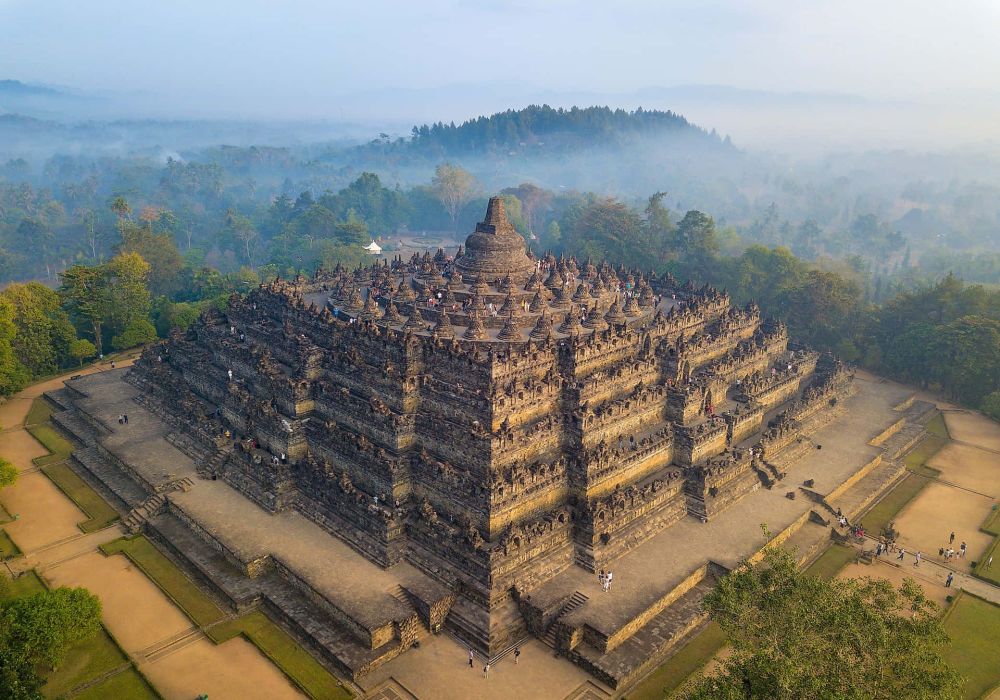
Standing quietly among the green landscapes of Central Java, Borobudur Temple is one of Indonesia's most remarkable cultural landmarks. More than a beautiful ancient monument, Borobudur tells stories about Buddhism, Javanese civilization, architecture, and a spiritual journey toward enlightenment.
If you are planning a trip to Yogyakarta or Central Java, here are 7 fascinating facts about Borobudur Temple that may make your visit even more meaningful.
1. Borobudur Was Built More Than 1,000 Years Ago
Borobudur dates back to the 8th and 9th centuries, during the reign of the Syailendra Dynasty in Central Java. The exact construction process remains a subject of historical and archaeological study, but the monument is generally associated with the Mahayana Buddhist tradition and the powerful civilization that flourished in Java at the time. Imagine building a monument of this scale more than a thousand years ago, using stone blocks and sophisticated architectural techniques—without modern machinery.
2. It Has 504 Buddha Statues
One of the most recognizable features of Borobudur is its collection of Buddha statues. The monument contains 504 Buddha statues, distributed throughout its different levels. Many of the statues are placed inside the perforated stupas on the upper circular terraces. Each statue is positioned with symbolic hand gestures, known as mudras, adding another layer of meaning to the monument's design.
3. There Are 72 Stupas at the Top
Look closely at the three circular terraces at the top of Borobudur and you will see 72 perforated stupas surrounding the large central stupa. Each of these smaller stupas contains a Buddha statue. Their openwork design creates the distinctive pattern that has become one of Borobudur's most recognizable visual features. Together with the central stupa, these structures form the spiritual climax of the monument.
4. Borobudur Has Thousands of Relief Panels
Borobudur is almost like a giant stone storybook. The monument contains 2,672 relief panels, consisting of narrative and decorative panels. The stories include scenes related to Buddhist teachings, the life of Buddha, moral lessons, and the journey toward wisdom. Some of the important narrative series include Karmawibhangga, Lalitavistara, Jataka-Avadana, and Gandavyuha. The reliefs also provide glimpses into aspects of everyday life in ancient Java, making Borobudur valuable not only as a religious monument but also as a window into the past.
5. Borobudur Represents a Spiritual Journey
Borobudur was not designed simply as a building to admire. Its architecture reflects the Buddhist concept of the universe and the journey toward spiritual liberation. UNESCO describes its structure through three levels: Kamadhatu, Rupadhatu, and Arupadhatu. In simple terms, visitors move from the lower world associated with desires, through the world of form, and toward the formless realm represented by the circular terraces at the top. So, walking upward through Borobudur can be understood as more than climbing a monument—it represents a journey toward enlightenment.
6. Borobudur Was Rediscovered in the 19th Century
At some point after its period of active use, Borobudur was gradually abandoned and became overgrown. The monument was rediscovered in 1814, during the period of British administration in Java, under the direction of Thomas Stamford Raffles. The site was subsequently cleared and documented, beginning a long process of archaeological study and conservation. Its story did not end with rediscovery. Major restoration work was carried out in the 20th century, including a large international restoration project supported by UNESCO.
7. Borobudur Is a UNESCO World Heritage Site
Borobudur was inscribed on the UNESCO World Heritage List in 1991. Interestingly, the UNESCO-listed property is not limited to Borobudur Temple alone. The Borobudur Temple Compounds also includes two nearby Buddhist temples: Mendut Temple and Pawon Temple, located along an axis to the east of Borobudur. UNESCO recognizes the complex as an outstanding example of Buddhist architecture and monumental art from the 8th and 9th centuries.
More Than an Ancient Temple
There is a reason Borobudur continues to attract travelers from around the world. It is not only about its enormous stone structure, countless carvings, or beautiful landscape. Borobudur offers a glimpse into the intellectual, artistic, and spiritual achievements of an ancient Javanese civilization. And perhaps the best way to appreciate it is not simply to take a photograph from the outside.
Walk through its terraces. Look closely at the reliefs. Notice the stories carved into stone. And take a moment to understand the journey that Borobudur represents.
Because at Borobudur, history is not simply something you read about.
It is something you walk through.
Comments
No comments yet! Be the first to share your thoughts.
